
CENTRAL TEXAS ROOFING MATERIALS GUIDE
Which Roof Is Right for Your Home?
Hail, 100-degree summers, wind, and sudden downpours: Central Texas is hard on roofs, and the best roofing material for Texas homes depends on your home, your budget, and how long you plan to stay. This guide compares every roof type we install side by side, with the honest trade-offs.
We install all of them, from shingles to slate. Metal is our specialty, and we’ll tell you so, but we’ll also tell you when it isn’t the right fit.
What Central Texas Does to a Roof
Every material handles these differently. Keep them in mind as you compare.
Hail
Central Texas sits in one of the most active hail regions in the country. Impact resistance matters here.
Heat and Sun
Long, hot summers dry out shingles, seals, and washers, and push attic temperatures up.
Wind
Spring storms lift shingle edges and tear off loose pieces, especially on older roofs.
Heavy Rain
Sudden downpours find weak flashing and valleys fast.
Big Temperature Swings
Hot days and cool nights make roofing expand and contract, working fasteners loose.
HOA Rules
Many neighborhoods limit materials and colors, so check before you choose.
Compare Roofing Materials Side by Side
Lifespans are typical planning ranges, not guarantees. Installation, ventilation, and maintenance change them. Cost tiers are relative, from $ (lowest) to $$$$ (highest).
| Material | Typical life | Hail | Heat | Weight | Upkeep | Cost | Best for |
|---|---|---|---|---|---|---|---|
| Asphalt shingles | 15–25 yrs | Fair; Class 4 options are strong | Ages faster in heat | Light | Low | $ | Budget, most homes |
| Standing seam metal | 40+ yrs | Can dent; rarely leaks | Excellent, esp. light colors | Light | Very low | $$$ | Staying long-term |
| Metal tile / stone-coated | 40+ yrs | Strong | Very good | Light | Low | $$–$$$ | Tile or shake look, light weight |
| Clay & concrete tile | 50+ yrs (underlayment 20–30) | Can crack | Excellent | Heavy | Low–medium | $$$ | Spanish & Mediterranean homes |
| Natural slate | Generations | Can break | Excellent | Very heavy | Low (needs a specialist) | $$$$ | Preserving an existing slate roof |
| Cedar shake | 20–30 yrs | Varies | Weathers, can split | Medium | High | $$$ | Rustic character |
| Synthetic slate & shake | Decades | Many Class 4 | Very good | Light | Very low | $$$ | High-end look, strong hail resistance |
| Flat: TPO / PVC | 15–30 yrs | Varies | White reflects heat | Light | Medium (drains) | $$ | Commercial & low-slope sections |
Your roof’s condition, pitch, framing, and ventilation all affect what makes sense. We’ll confirm on site.
Finding the Best Roofing Material for Texas: What Matters Most to You?
Most homeowners have one priority that decides it. Find yours.
| If you want… | Look at | Why |
|---|---|---|
| The lowest upfront cost | Architectural shingles | Least expensive to install and repair, with a wide range of colors. |
| To never re-roof again | Standing seam metal | Decades of life, concealed fasteners, and very little upkeep. |
| The best shot against hail | Class 4 shingles, metal, or synthetic | Built and tested to take impacts, and many insurers offer a discount. |
| The slate or shake look without the weight | Synthetic, or metal shaped like shake | The look of stone or wood on standard framing. |
| A Spanish or Mediterranean style | Clay/concrete tile, or metal tile | Real tile if the framing allows it; metal tile if it doesn’t. |
| A cooler attic | Light-colored metal or a white membrane, plus good ventilation | Reflective surfaces and airflow keep heat out of the house. |
| To fix a flat or low-slope section | TPO or PVC membrane | Made for low slopes, where shingles and metal panels don’t belong. |
MOST COMMON
Asphalt Shingles
Most Central Texas homes have asphalt shingles, and for good reason: they cost the least up front, suit almost any style, and are easy to repair. The difference between a shingle roof that lasts and one that doesn’t usually comes down to three things: the shingle you pick, the attic ventilation under it, and how carefully it’s installed.
Architectural shingles are the standard today: thicker, dimensional, and better in wind than old flat 3-tab shingles, which we don’t recommend. Impact-resistant (Class 4) shingles are built to survive a 2-inch steel ball test without cracking. They cost more than standard architectural shingles, but in a hail corridor like ours they’re worth pricing, and many insurers offer a discount for them.
A strong fit if you:
- Want the lowest upfront cost
- May sell in the next 10–15 years
- Need to match an HOA’s existing look
Think twice if you:
- Plan to stay 25+ years and want to avoid another replacement
- Have had repeat hail claims (look at Class 4 or metal)
OUR SPECIALTY
Standing Seam Metal
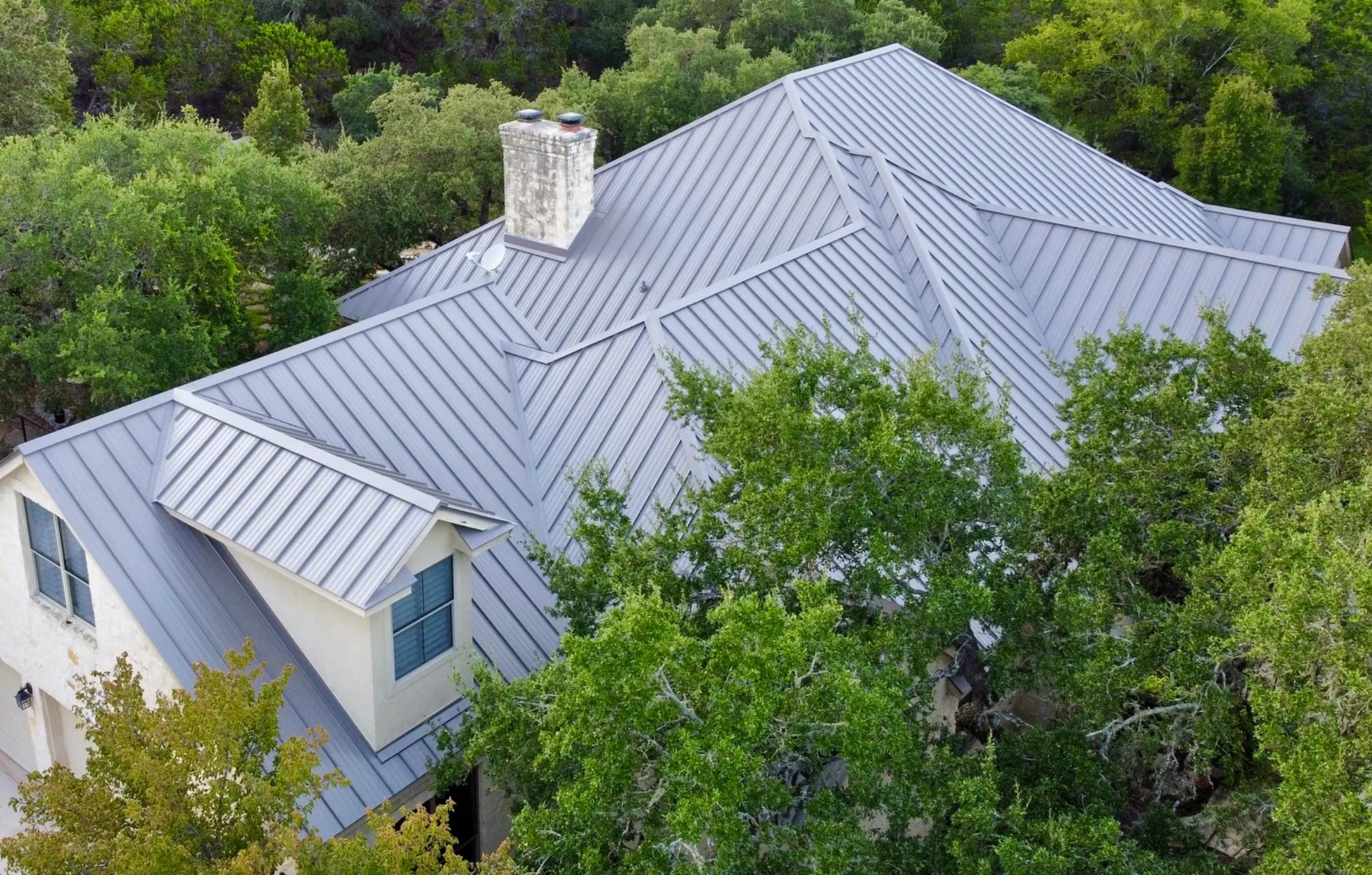
Standing seam is the metal roof most people picture on a modern Hill Country home: long continuous panels, raised seams, and no exposed screws. Because the fasteners sit under the panels, there are no rubber washers to dry out in the sun, which is the most common failure point on cheaper metal roofs.
It handles Texas heat well, especially in lighter or reflective finishes, and it sheds heavy rain fast. Large hail can dent it. Most dents are cosmetic and don’t affect how the roof performs, but that matters for insurance: some Texas policies exclude cosmetic damage on metal roofs, so read yours. It costs more up front than shingles, and the payoff is that many owners never replace the roof again.
A strong fit if you:
- Plan to stay in the home long-term
- Want a clean, modern, or Hill Country look
- Are tired of replacing shingles after storms
Think twice if you:
- Need the lowest possible upfront price
- Have a policy that won’t cover cosmetic hail dents and that worries you
THE LOOK OF TILE OR SHAKE
Metal Tile & Stone-Coated Steel
Metal can also be shaped to look like clay tile, shake, or slate. Stone-coated steel adds a granular finish that hides dents and softens the metal look. Both give you the style of a heavier roof at a fraction of the weight, which matters on homes that were never framed for real tile.
This is what we installed on the sloped roofs at Giovanni’s Italian Restaurant: Worthouse metal tile that kept the building’s Mediterranean character.
A strong fit if you:
- Love the look of tile but your framing can’t carry it
- Want strong hail performance with a textured look
Think twice if you:
- Prefer the clean lines of standing seam
- Want the lowest cost option
SPANISH & MEDITERRANEAN
Clay & Concrete Tile
Tile is a classic in Central Texas, from Spanish-style homes to Mediterranean builds in San Antonio. The tiles themselves can outlast almost anything, but here’s what many homeowners don’t know: the underlayment beneath the tile usually wears out first, often in 20–30 years. When a tile roof leaks, it’s usually the layer underneath, not the tile.
Tile is heavy, so a home switching to tile needs its structure checked. Large hail can crack tiles, and walking on tile incorrectly breaks more of it, so repairs need a crew that knows tile. We repair and install clay, concrete, and Spanish tile, including matching older tile.
A strong fit if you:
- Already have tile and want to keep the look
- Want a roof surface that lasts for decades
Think twice if you:
- Have a home not framed for the weight
- Want the easiest roof to repair after hail
NATURAL STONE
Natural Slate
A well-installed slate roof can outlast the people who put it on. It’s also the easiest roof to damage in the wrong hands: walking on slate incorrectly or using the wrong fasteners can break more slate than a repair fixes. On most slate roofs, it’s the fasteners and flashing that wear out first, not the stone.
If you have slate, the right move is usually careful repair and restoration, not replacement. If you want the slate look on a home that isn’t built for the weight, look at synthetic slate below.
A strong fit if you:
- Already own a slate roof worth preserving
- Want the most permanent roof available
Think twice if you:
- Have standard framing (slate needs a heavy-duty structure)
- Want a lower-cost path to the look
NATURAL WOOD
Cedar Shake
Cedar shake gives a home warm, rustic character that nothing else quite matches. In Texas, it asks more of you than other roofs: sun, heat, and moisture cycles cause splitting, cupping, and moss, and it needs regular care to reach its full life. Wood also brings fire-rating questions that some neighborhoods and insurers ask about.
We repair and restore cedar shake roofs, and we’ll tell you honestly when a synthetic shake would serve you better.
A strong fit if you:
- Already have cedar and love it
- Are willing to keep up with maintenance
Think twice if you:
- Want a low-maintenance roof
- Live where fire rating or insurance is a concern
SLATE & SHAKE, ENGINEERED
Synthetic Slate & Shake
Synthetic roofing is molded to look like natural slate or cedar shake, without the weight of stone or the upkeep of wood. Many products carry a Class 4 impact rating, which makes them a strong fit for Central Texas hail. We install DaVinci and Brava.
It costs more than shingles and sits closer to metal. It also takes a crew that knows the product, because manufacturer warranties depend on proper installation.
A strong fit if you:
- Want the slate or shake look without the weight
- Want strong hail resistance with a high-end look
Think twice if you:
- Need the lowest upfront cost
- Want real natural stone or wood
LOW-SLOPE & COMMERCIAL
Flat & Low-Slope Roofs (TPO, PVC)
Flat and low-slope roofs are common on commercial buildings and on sections of many homes, like porches and additions. Single-ply membranes such as TPO and PVC are the go-to choices today, usually in white, which reflects Texas sun and helps with cooling.
On a flat roof, drainage and detailing decide success more than the membrane brand does. Standing water, clogged drains, and rooftop equipment are where problems start. At Giovanni’s, we installed a white Versico membrane on the flat section under the rooftop HVAC units while the restaurant stayed open.
A strong fit if you:
- Have a commercial building or a low-slope section
- Want a reflective roof to cut heat
Think twice if you:
- Have a pitched roof (you need a steep-slope material)
Hail Ratings, Explained
Roofing is impact-rated under a standard called UL 2218. Steel balls are dropped from about 20 feet onto the roofing. To pass a class, it can’t crack or split.
| Rating | Steel ball size | What it means here |
|---|---|---|
| Class 1 | 1¼ inch | Minimal protection |
| Class 2 | 1½ inch | Light hail |
| Class 3 | 1¾ inch | Moderate hail |
| Class 4 | 2 inch | The highest rating, and the one to look for in Central Texas. Many insurers offer a discount. |
A rating describes a lab test, not a promise against every storm. Very large hail can still damage Class 4 roofing.
Worried about a recent storm? Read our hail damage guide →
The Material Is Only Part of the Roof
The best shingle or panel will still fail early if what’s under and around it is wrong.
Underlayment
The waterproof layer under your roofing. On tile roofs, it usually wears out before the tile.
Ventilation
A hot, stuffy attic cooks roofing from below. Balanced intake and exhaust extend its life.
Flashing
Chimneys, walls, valleys, and skylights are where most leaks start. Details matter more than material.
Installation
Manufacturer warranties often depend on proper installation, so who installs it matters.
Decking
Soft or damaged decking should be replaced during a tear-off, not covered over.
Gutters and Drainage
Water has to leave the roof edge cleanly, or it finds its way back in.
Insurance, HOAs, and Energy: What to Check First
Insurance
- Many Texas insurers offer a premium discount for Class 4 impact-resistant roofing. Ask your agent how much.
- Some policies exclude cosmetic hail damage on metal roofs. Know what yours says before you choose.
- How roof insurance claims work →
Your HOA
- Most HOAs require approval before a new roof. Submit before you sign.
- Texas law (Property Code §202.011) generally keeps HOAs from banning roofing designed to resist wind and hail or to improve energy efficiency, as long as it fits the look of the neighborhood.
- We can help you put together the product details your HOA asks for.
Energy and Heat
- Lighter and reflective colors keep more heat off the roof deck.
- Ventilation matters as much as color for attic temperature.
- Paying for a new roof →
Questions to Ask Before You Choose
- How long do I plan to stay in this home?
- Has this roof, or this neighborhood, had repeated hail claims?
- What does my HOA allow, and what does it require for approval?
- Can my home’s framing carry tile or slate?
- Does my insurance policy exclude cosmetic damage on metal?
- Is upfront cost or long-term cost more important right now?
When to Have Your Roof Evaluated
- After a hail or wind storm, even if nothing is leaking
- When a shingle roof reaches about 12–15 years old
- Before you buy or sell a home
- When you see granules in the gutters or shingles in the yard
- Before you get quotes for a new roof, so you know what it needs
See These Materials on Real Central Texas Homes
Standing Seam Metal · Dripping Springs
One continuous system over a limestone Hill Country home. View project →
Metal Tile & Membrane · San Antonio
Worthouse metal tile plus a white Versico flat roof, done while the restaurant stayed open. View project →
Shingle Replacement · Round Rock
A new shingle roof with Catch-All protection keeping debris out of the landscaping. View project →
TAMKO Pro Platinum · BBB Accredited · Fully Insured · 25-year workmanship warranty on metal, 10-year on shingle
NOT SURE YET?
Let’s Look at Your Roof Together
We’ll look at your roof, your framing, and your HOA rules, then walk you through the two or three options that actually make sense for your home, with written prices.
- Free, no-obligation estimate
- Honest recommendation, even if it isn’t metal
- Samples and color options
- Questions? Call 512-271-6893
"*" indicates required fields
Roofing Materials Questions
What is the best roofing material for Texas?
There isn’t one best roofing material for Texas homes; it depends on the house. For the lowest upfront cost, architectural or Class 4 shingles. For the longest life and least upkeep, standing seam metal. For a high-end look with strong hail resistance, synthetic slate or shake. The right answer depends on your budget, how long you’ll stay, your HOA, and your home’s framing.
Are Class 4 shingles worth it in Texas?
In a hail-prone area, they’re worth pricing. They cost more than standard architectural shingles, and many Texas insurers offer a premium discount for impact-resistant roofing. Ask your agent what yours offers, then compare that against the upfront difference.
Will hail dent a metal roof?
Large hail can dent metal. Most dents are cosmetic and don’t affect how the roof sheds water, and metal won’t crack or lose granules like shingles. Some Texas policies exclude cosmetic damage on metal roofs, so check yours.
Is a metal roof loud in the rain?
Over a solid roof deck with underlayment, which is how we install them, a metal roof is typically no louder inside than other roofs.
How long does a roof last in Texas?
As a planning guide: shingles about 15–25 years, metal 40+ years, and tile 50+ years, with the underlayment under tile often needing attention sooner. Heat, hail, ventilation, and installation all change those numbers. More on roof lifespan in Texas →
Can my HOA stop me from choosing a certain material?
HOAs can require approval and set appearance standards. Texas law generally keeps them from banning roofing designed to resist wind and hail or to improve energy efficiency, as long as it fits the neighborhood’s look. Always submit for approval before you sign a contract.
Can I switch from shingles to tile or slate?
Sometimes, but tile and slate are heavy, and the home’s framing has to be checked first. If it can’t carry the weight, metal tile or synthetic slate gives you a similar look at a fraction of the weight.
What’s the difference between standing seam and other metal roofs?
Standing seam hides its fasteners under the panels. Cheaper exposed-fastener metal uses screws with rubber washers through the face of the panel, and those washers dry out in the Texas sun and need attention over time.
Do roof color and material affect energy bills?
They can. Lighter and reflective roofs absorb less heat, and a white membrane on a flat roof reflects a lot of sun. Attic ventilation matters just as much for keeping heat out of the house.
Which brands do you install?
We install products from manufacturers including TAMKO, CertainTeed, Owens Corning, Worthouse, DaVinci, Brava, and Versico, and we’ll recommend the product that fits your roof, not the one with the best margin.
Ready to Compare Options for Your Home?
Get a free estimate with written prices for the materials that fit your roof, your HOA, and your budget.