

Commercial Roofing Contractor in Austin & Round Rock, TX
Repairs, replacements, metal and membrane roofs for businesses, churches and multifamily buildings, with free assessments.
COMMERCIAL ROOFING · AUSTIN, ROUND ROCK & SAN ANTONIO
Commercial Roofs Planned Around Your Building and Your Business
When a commercial roof leaks, the problem is bigger than the roof: tenants, customers, inventory, and equipment are underneath it. We provide commercial roofing in Austin, Round Rock, and across Central Texas, repairing and replacing membrane, metal, and mixed-system roofs on restaurants, retail, offices, and other working buildings.
Every project starts with an assessment on the roof, a photo report of what we find, and a straight answer on whether you need a repair, a coating, or a new roof. Then we plan the work around how your building actually runs.
Based in Round Rock
Offices in Round Rock and San Antonio.
Fully Insured
Certificates of insurance on request.
Safety-Planned Job Sites
Fall protection for every crew member.
BBB Accredited
Local and accountable.
Commercial Roofing Services
One roofing contractor for the whole roof: the membrane, the metal, the edges, and the details where they meet.
Commercial Roof Repair
Leaks at seams, curbs, drains, parapets, and rooftop units, traced to the source and fixed, with photos before and after. A good repair can buy years while you plan a replacement.
Commercial Roof Replacement
Full tear-off and a new roof system chosen for your building: how it drains, what sits on it, and how long you plan to own it. Damaged decking is replaced before the new roof goes on.
Commercial Roof Assessments
A walk of the whole roof with photos and written findings, so you can plan repairs or budget for replacement. Useful before a purchase, a lease renewal, or a capital plan.
Commercial Metal Roofing
Standing seam and metal tile for commercial buildings, including converting a failing flat section to standing seam where the structure allows. Metal is our specialty.
Coatings and Restoration
On a roof that is still sound and dry underneath, a coating can seal minor leaks and reflect heat for less than replacement. We will tell you plainly when a roof is not a good candidate.
Storm Damage on Commercial Roofs
After hail or wind, we inspect and document the damage with photos and a detailed estimate you can give your insurance carrier.
Learn more about metal roofing, roof coatings, and storm damage roofing.
Commercial Roof Systems We Work With
The right system depends on the building: how much slope the roof has, what sits on it, what comes out of the vents, and how long you plan to own it.
PVC Membrane
A single-ply thermoplastic membrane with heat-welded seams that fuse into one sheet. PVC resists grease and oils better than other single-ply membranes, which makes it the usual choice for restaurants and kitchens with rooftop exhaust. It typically costs more than TPO. We installed a Versico PVC system over a new deck at Giovanni’s in San Antonio.
TPO Membrane
One of the most widely installed single-ply membranes on commercial roofs, and one we install, repair, and replace. Like PVC, its seams are heat-welded and its white surface reflects Texas sun. It is a cost-effective choice where grease and chemicals are not reaching the roof. See how TPO and PVC compare.
Commercial Metal: Standing Seam and Metal Tile
Standing seam panels run continuously from eave to ridge with raised, concealed-fastener seams, leaving far fewer places for water to get in than exposed-fastener panels. Metal tile gives a Mediterranean or Spanish-style building the look of clay at a fraction of the weight. Metal needs enough slope to shed water, so low-slope sections are built up before panels go on, as we did in Burnet. More on standing seam metal roofing.
Roof Coatings
Silicone and acrylic coatings form a seamless layer over an existing membrane or metal roof. They extend the life of a sound roof; they do not fix a wet one. Insulation must be dry and damaged areas repaired first. See roof coatings.
Older Systems: EPDM, Modified Bitumen, Tar and Gravel
Many older Central Texas buildings still have rubber (EPDM), modified bitumen, or built-up tar-and-gravel roofs. When these roofs reach the end of their life, we replace them with a membrane or metal system chosen for how the building drains and what sits on it.
Which system fits?
- Restaurant or kitchen exhaust: PVC
- Office, retail, or warehouse with a low-slope roof: TPO or PVC
- Building that can take some slope: standing seam metal
- Mediterranean or Spanish style: metal tile
- Sound, dry roof with years left: a coating may be enough
We recommend a specific system and manufacturer after seeing the roof.
Flat and Low-Slope Roofs: Where Commercial Roofs Fail
“Flat” roofs are built with a slight slope so water reaches drains, scuppers, or gutters. Most commercial flat roof leaks trace back to one of four places. More on how flat roofs drain and where they fail.
Drainage and Ponding
Water that sits after a rain shortens a membrane’s life. We check drains, scuppers, and slope.
Rooftop Equipment
Curbs need their own flashing, and we coordinate with your HVAC contractor so new units sit on a new roof.
Parapets, Coping, and Edges
New metal coping and edge metal keep water out of the top of the wall.
What’s Under the Membrane
Wet insulation adds weight and rots the deck, so we check for it before recommending a coating.
Custom coping, edge metal, and crickets are covered on custom sheet metal.
Repair, Restore, or Replace?
We recommend the option that fits the roof’s condition and how long you plan to own the building, not the biggest job.
| Repair | Coating or restoration | Replacement | |
|---|---|---|---|
| Fits when | Leaks are isolated to seams, flashing, or penetrations | The roof is sound, mostly dry underneath, and aging evenly | Leaks are widespread or keep returning; insulation is wet across large areas; the deck is damaged |
| What it does | Fixes the specific failure | Adds a new waterproof, reflective surface over the existing roof | A new roof system from the deck up |
| What it won’t do | Stop a roof that is failing everywhere | Fix wet insulation, a rotted deck, or a drainage problem | Nothing left to defer |
| Good for | Buying time while you budget | Extending life for less than replacement | Long-term ownership and roofs past their life |
More on roof repair, roof coatings, and roof restoration.
Working Around an Open Building
Commercial buildings usually need to stay open while the roof is replaced. We can’t promise no disruption, but we plan for it and tell you what to expect before work starts.
Before work starts
We walk the site with you to plan staging, deliveries, lift access, and which entrances stay open. Large jobs are phased so only one part of the roof is open at a time. We talk through noise and odor so you can let tenants know.
On site
Staging is fenced or coned off, entrances are kept clear and safe, and debris goes straight into containers. The roof is dried in at the end of each day and the site is cleaned daily.
Communication
One point of contact from the first walk to the final walkthrough. You get updates when plans change for weather, and photos of every phase.
Safety
We plan fall protection for each roof before work starts: harnesses for every crew member, warning lines on low-slope roofs, and hard hats when work is overhead. We are fully insured, and certificates of insurance are available on request.
Giovanni’s stayed open
On Giovanni’s Italian Restaurant in San Antonio, we replaced every roof on the building and coordinated with the rooftop HVAC replacement while the restaurant kept serving customers.
Commercial Roof Projects
Two recent buildings, two very different roofs.
Giovanni’s Italian Restaurant, San Antonio
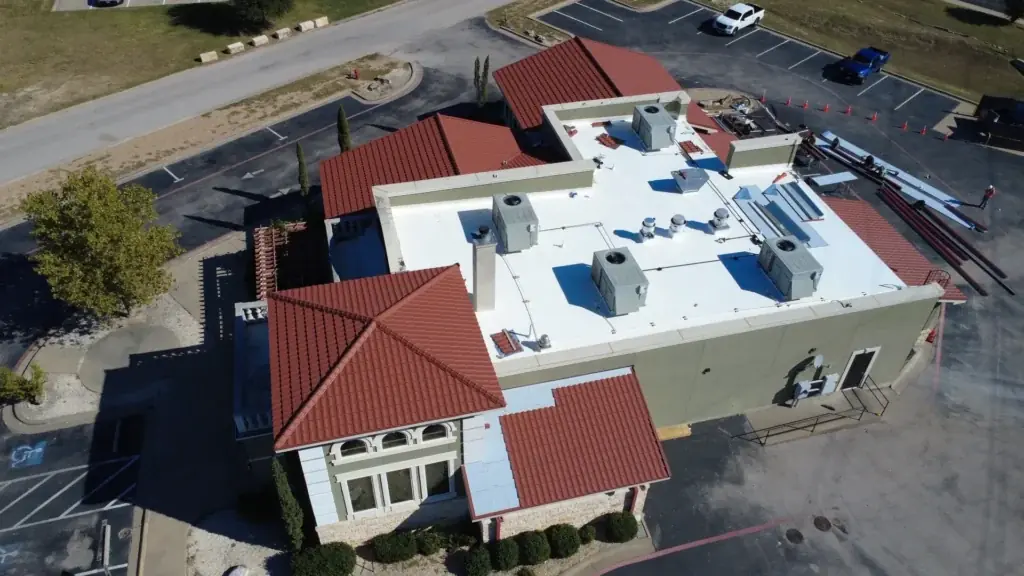
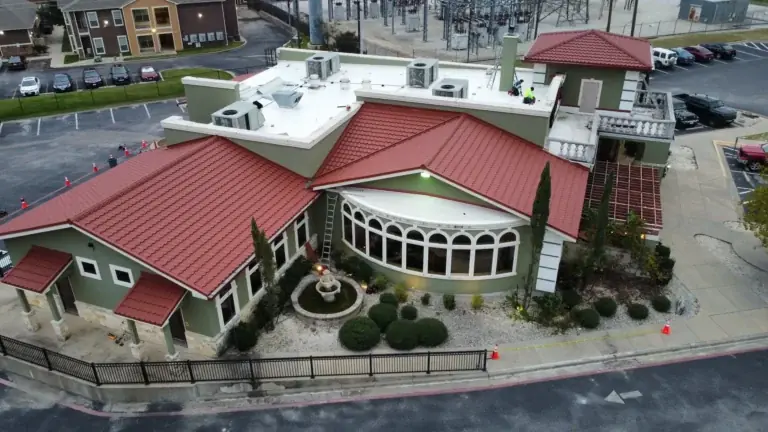
A Mediterranean-style restaurant with sloped tile-look roofs, a flat center roof carrying the kitchen exhaust and HVAC, a curved roof over the dining room, and a tower. We installed Worthouse Supre metal tile on the sloped roofs, a Versico PVC membrane over a full re-deck on the flat roof, new metal coping, and custom 6-inch gutters. The restaurant stayed open the whole time.
Commercial Metal Roof Replacement, Burnet
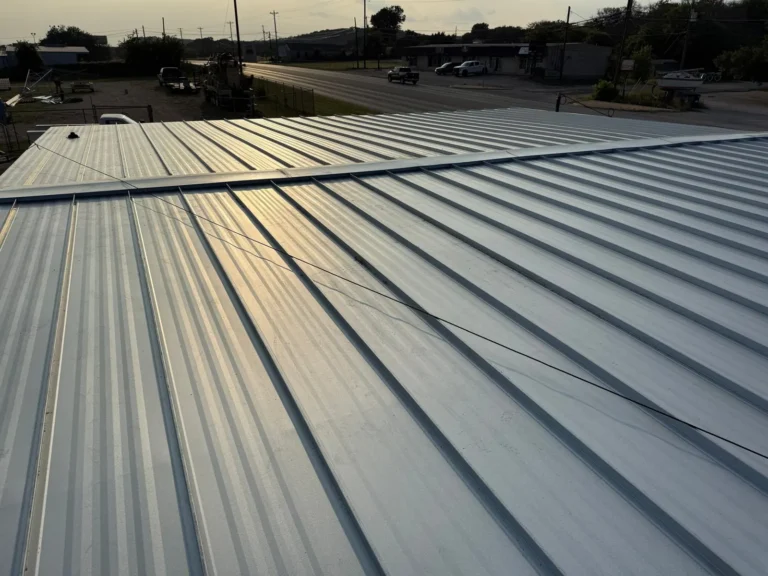
A building that leaked every rain: an old tar-and-gravel flat section and metal sections with failing seams. After the owner’s claim was paid, we replaced the flat section with standing seam metal over synthetic underlayment and wood purlins, with new ridge and trim details.
Buildings We Work On
Every building type puts different demands on a roof project: who is inside, what sits on the roof, and when the work can happen.
Restaurants
Grease from kitchen exhaust, rooftop equipment, and customers who can’t be turned away. Membrane choice and phasing matter most.
Retail and Shopping Centers
Storefront entrances stay open, and staging and deliveries are planned around parking and peak hours.
Offices
Rooftop HVAC, tenants under the work, and noisy work planned around the workday.
Churches
Steep slopes, towers, and a schedule built around services and events.
Multi-Family and Assisted Living
Several roofs on one property, and residents to keep safe and informed.
Warehouses and Metal Buildings
Large low-slope or metal roofs where leaks threaten inventory and equipment.
How a Commercial Roof Assessment Works
We walk the whole roof, not just the leak: the membrane or panels, seams, flashing at curbs and walls, drains and gutters, rooftop equipment, past repairs, and the edges. Inside, we look at stains and ceiling damage to match them to what is above.
You get a photo report of what we found and a recommendation: repair, coat, replace, or monitor. If work is needed, you get a written proposal with the scope, materials, and schedule.
What a visual assessment can’t tell you: how much insulation is wet under the membrane. When that matters, for example before a coating, we’ll recommend a moisture survey or test cuts. We don’t provide engineering or structural design; if your building needs it, we’ll say so and work with your engineer.
How a Commercial Project Runs
Clear communication and careful planning from the first call to closeout.
01
First Call
Tell us about the building, the problem, and any deadline. We set a time to see the roof.
02
Roof Assessment
We inspect the roof and the signs inside, with photos of everything we find.
03
Written Proposal
Repair, coating, or replacement, with the system, scope, and schedule in writing. If damaged decking turns up during tear-off, we photograph it and update the price first.
04
Planning
Staging, access, phasing, and timing worked out with you, your property manager, and other trades such as HVAC.
05
The Work
Installation by our crew, dried in daily, with photo updates as each phase finishes.
06
Walkthrough and Closeout
We walk the roof with you, hand over the photo report and warranty paperwork, and clean up the site.
Warranties on Commercial Roofs
A commercial roof can carry up to three kinds of warranty, and it is worth knowing which you are getting.
Material Warranty
From the manufacturer. Covers defects in the product itself.
System or NDL Warranty
From the manufacturer, on certain systems only. Covers materials and labor for leaks caused by the system, usually after a manufacturer inspection. Giovanni’s PVC roof carries a 20-year no-dollar-limit warranty.
Workmanship Warranty
From us. Covers our installation: 25 years on metal roofs. Terms for membrane and coating work are written into your proposal.
Coverage, exclusions, and maintenance requirements differ by product. We show you the actual warranty terms with your proposal.
Commercial Roofing Across Central Texas
Central Texas is hard on commercial roofs, and each season tests a different part of the roof.
Hail
Spring storms can puncture membranes, crack old coatings, and dent metal panels and gutters.
Heat and Sun
Long summers bake dark roofs and age seams. White membranes and reflective coatings cut heat on the roof.
Heavy Rain
Downpours find slow drains and low spots. Oversized gutters and clear drains keep water moving.
Rooftop Traffic
HVAC service visits wear paths in membranes. Walk pads and new curbs protect the roof around equipment.
From our offices in Round Rock and San Antonio, we work on commercial roofs in Austin, Round Rock, Georgetown, Cedar Park, Pflugerville, San Antonio, and the Hill Country, including Burnet and Marble Falls. See all service areas.
What Customers Say After the Work Is Done


 Trustindex verifies that the original source of the review is Google.
 Trustindex verifies that the original source of the review is Google.
 Trustindex verifies that the original source of the review is Google.
 Trustindex verifies that the original source of the review is Google.
 Trustindex verifies that the original source of the review is Google.
 Trustindex verifies that the original source of the review is Google.
 Trustindex verifies that the original source of the review is Google.
 Trustindex verifies that the original source of the review is Google.
 Trustindex verifies that the original source of the review is Google.
 Trustindex verifies that the original source of the review is Google.
COMMERCIAL ASSESSMENT
Request a Commercial Roof Assessment
Tell us about the building and the roof. We’ll call to set a time to see it.
- Whole roof walked and photographed
- Written findings and a clear recommendation
- Fully insured, certificates on request
- Leaking now? Call 512-271-6893
"*" indicates required fields
Commercial Roofing: Common Questions
Can you work on our roof while the business stays open?
Usually, yes. We phase the work so only part of the roof is open at a time, keep entrances clear and staging fenced off, and clean up daily. We talk through noise and timing before work starts. Giovanni’s Italian Restaurant stayed open throughout its re-roof.
What commercial roof systems do you install?
TPO and PVC single-ply membranes, standing seam metal, metal tile, and roof coatings, plus the coping, edge metal, and gutters that go with them. We recommend a system after seeing the roof.
How do I know if our commercial roof needs replacing?
Widespread or returning leaks, wet insulation across large areas, a soft or rotted deck, and a membrane that is shrinking, cracking, or splitting at the seams are the main signs. A roof assessment tells you which you are dealing with.
Can a coating extend the life of our roof?
Sometimes. A coating can add years to a roof that is sound and dry underneath. It won’t fix wet insulation or a damaged deck, and it can’t make up for poor drainage. We’ll tell you honestly if your roof is not a candidate.
What is the difference between TPO and PVC?
Both are white, heat-welded single-ply membranes, and we install both. PVC resists grease and oils better and usually costs more, so it is the common choice for restaurants. TPO is a cost-effective choice where grease is not an issue. See our flat roofing page for a full comparison.
Can a flat roof be replaced with metal?
Often. Metal panels need slope to shed water, so the flat section is built up first. In Burnet, we installed wood purlins over the deck before the standing seam went on. Whether it works depends on the structure, which we check.
What affects the cost of a commercial roof?
Roof size, the system chosen, the condition of the deck and insulation, the number of curbs and penetrations, access and height, and scheduling needs such as phasing. We give a written price after seeing the roof.
How long does a commercial roof replacement take?
It depends on size and phasing. A small building may take a few days; a larger or phased job can take a few weeks. Giovanni’s took a few weeks on site. Your proposal includes a schedule.
Do you inspect commercial roofs after storms?
Yes. We document hail and wind damage with photos and a detailed estimate you can share with your insurance carrier. In Texas, a roofing contractor can’t negotiate a claim for you, but we can document the roof’s condition. See roof insurance claims.
Do you work with property managers?
Yes, including owners and managers of several buildings. You get one point of contact, photo updates, and certificates of insurance on request.
Planning a Commercial Roofing Project?
Tell us about the building. We’ll assess the roof, explain your options, and give you a written proposal built around how your property runs.